

On Persepolis
& making revolutionary art

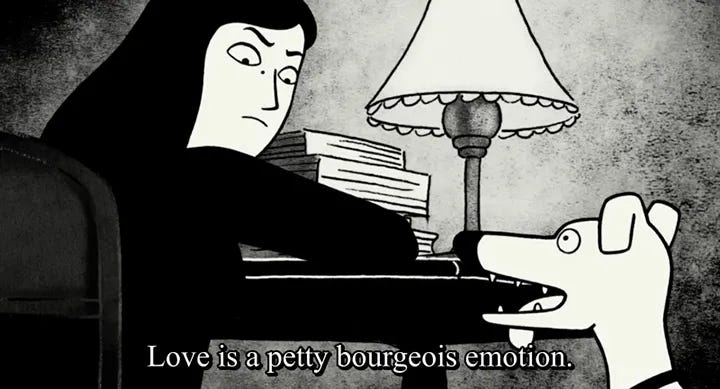
Like many of us, I was stunned to find that Marjane Satrapi, the genius mind behind the comic book (and film) Persepolis, died a few weeks ago. All reports say she died of a broken heart; how poetic, the utter tragedy of an artist’s eventual demise.
It made me think of how many people, through time, die—whether in subconscious or literal ways—due to a heartbreak. In Marjane’s case, it was the death of a partner, only a year earlier, that triggered this tumult. Understanding this made me feel so distraught that I didn’t know what to do with my second-hand grief, so I watched Persepolis to understand mine better, and perhaps hers, too.
The last time I had properly read the comic book was almost twenty years ago. Soon after I had moved to New York City, I found a cheap copy in The Strand and devoured it in one sitting. I can’t remember if I had read it earlier, or if that was my first time with the book, but I know that I had known of it, as one did back then, through the flurry of chat rooms or internet gossip. Maybe Tumblr, like many things, had introduced me to her work. Whatever it was, I still remember the absolute thrill of finding it, of feeling alive, of being seen by art, which happened so rarely (at the time) for a Muslim kid like me.
I guess it makes me sad that someone so brilliant could die of heartbreak. It’s so Johnny and June Carter Cash, it’s so poetic… it’s so Iranian… the drama of one’s fate, the Promethean stakes we take for love. I think of another Iranian who died young, Forough Farrokhzad, who was first introduced to me by the artist Shirin Neshat when I interviewed her for Cultured Magazine back in 2018. The first time I read Farrokhzad I felt this blight, a weight pounding in my chest; the agony of love lost. Her misery was so palpable that it became mine, too.
“Hark! Do you hear the whisper of the shadows?
This happiness feels foreign to me.
I am accustomed to despair.
Hark! Do you hear the whisper of the shadows?
There, in the night, something is happening
The moon is red and anxious.”
Farrokhzad writes these words in The Wind Will Carry Us. She was a December Capricorn, who, I believe, are more tempered by their emotional darkness than their January Capricorn counterparts. Marjane, unsurprisingly, was right on the cusp of Sagittarius, with her Sun at 29 degrees of Scorpio, along with her Venus there as well. Feelings of intensity, love, and romantic relationships being the utmost important thing—it is the very lifeblood that defined her—but maybe it’s also the thing that set her free. Perhaps this is sadistic of me, but I keep wondering what she was thinking in her final hours. What led her to the final throes of her death?
I think part of the reason we are not healed as a society is that we refuse to look at death. It is just a byproduct of this life, not something that we must contemplate or prepare for. As a death and grief worker, I encounter death a lot in my life, and maybe like other freaks like me, I can hold a lot of it. For me, it was the death of my early life sexual abuse that deadened me from this mortal plane, which has also given me such scope to hold the many different permutations of what life is and can be. I can hold the muck of it, the gravity of it, because I have known loss of self so intimately, and so young, severing from the safety of maternal love. When you are unmoored from a young age, that can bring about many deaths of self as well.
But my parents are also direct genocide survivors. I think that does something to the psyche that is passed on. It becomes cellular data that is waiting to be released.
I recently had lunch with my friend Marwan, whose father was the revolutionary Lebanese musician, Ahmed Kaabour. He recently died of cancer, and for most of our lunch, we cried and spoke of his death. We circled it around and around. He talked of his father’s months before his final breath, and also what it’s like to lose somebody who meant so much to so many people. In his case, it’s also both the death of a parent and the death rattle of Zionist aggression, the violence that continues.
A new friend, Yasmina, who photographed me for Al Hayya magazine recently, told me about living in Beirut. “It’s the third war I’ve survived,” she said when I asked her how she was. “I’m only 28.” I went on to ask her about her health, and she told me about the cancer she survived at 16. “It’s from the bombs. So many people have gotten cancer from the bombs.”
When I started researching Who Is Wellness For? I already knew a lot about cancer, diseases, and illnesses. As someone who has been a healer for a long time, I knew there was a correlation to environment, as much as there was a connection to trauma, upbringing, and familial histories/lineages.
This is what we don’t think of when we think of modern warfare. In the case of Israel, there is no humanizing its aggression. It is genocidal, and it wants the total annihilation of the land and its people: Palestine, Lebanon, and Iran… Fuck it’ll engulf Egypt, Yemen and Saudi Arabia, too, it doesn’t give a fuck. In fact, Zionist aggression has murdered around 4,000 Lebanese since March 2nd. Just take that in. I’ve seen multiple friends over the last few months post buildings in residential blocks in Beirut being pummeled. As an international community, what do we do? Most of you probably didn’t even know the severity of it. As I talked to Yasmina, my heart felt heavy witnessing her disassociation, knowing that’s the only way one can survive such horror. She said that, too, fully self-aware. “We go on. We live. We make art. We disassociate.” The cycle continues.
The more Israel continues to do what it is doing to this world, the more they increase the levels of death and destruction everywhere, but also sickness across the region. The bombs they have blasted were worse than Hiroshima and Nagasaki months into the carnage that started in Gaza from October 2023 onwards. Still, as it continues, years later, it’s final last hurrah, what it doesn’t understand, as colonizers rarely do, is that this karmic and spiritual violence will catch up to them. A lot can happen in a lifetime.
I think it is here, in the naming of it, that our humanity and purpose lie. I felt so much grief knowing that Yasmina’s story is not singular; this is also the result of the bloated ego and reckless warmongering of empire. This is happening in Sudan. This is happening in Congo. And do you know why? It’s because the “West” (and also the UAE and Saudi Arabia…) pay mercenaries to rape and kill and exploit people’s resources and land so they can take it, silently, in the night. Recently, a white French woman said to me, speaking of the French colonies, “They wouldn’t know what to do with it.” I was so shocked, momentarily, but I managed to say: “That’s racist.” The anti-Blackness is astonishing.
It’s the same tonality of Golda Meir (a former genocidal Israeli PM), whose rationality was thus: “We can forgive the Arabs for killing our children. We cannot forgive them for forcing us to kill their children.” YOU CHOSE TO KILL THEM.
Colonial logic is so sadistic. You kill, at least own it. Why lie about it?
Afterwards, I thought of how modern warfare is particularly violent. How Zionist technology is so menacing—the beeper attacks in Lebanon, just one example, seen as a victory for NYT pundits like Thomas Friedman—because there is no morality to Zionist aggression. It is pure sadistic terror. That is the terror of empire, to take and take and take and then blame it on the indigenous, local population—as if they are insects. Apparently, we’re too uncivilized to enjoy the profundity of our lands, our resources, this world… This is what they tell themselves to keep justifying murder.
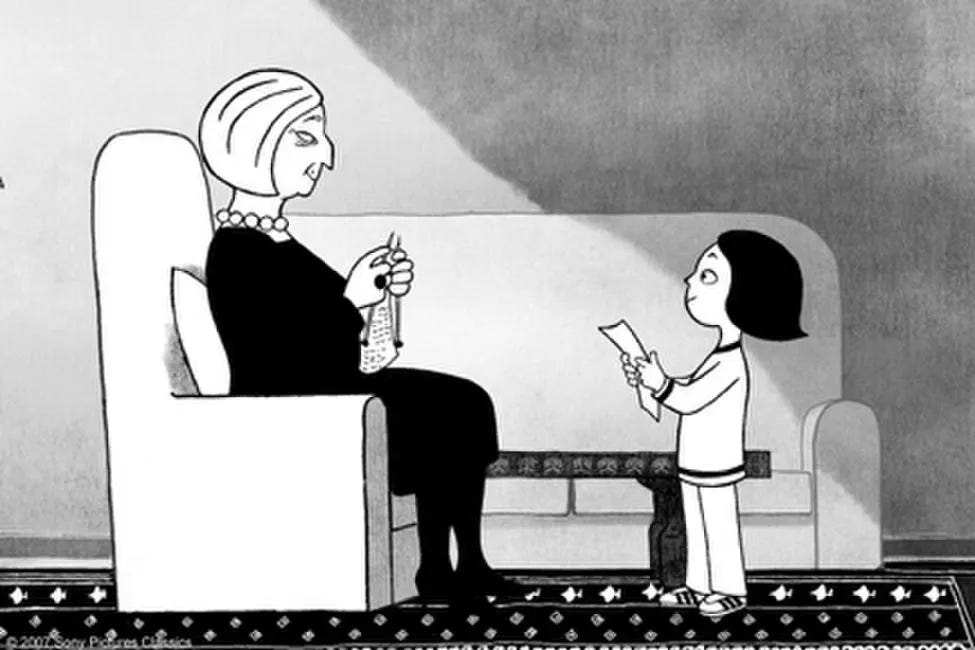
Unsurprisingly, watching Persepolis made me cry. I felt the loss of home, what happens to families when societies begin to crumble due to the anarchy of political systems and bodies. There is a particular kind of diasporic agony of being taken from the roots, which I think is a part of the protracted colonial game. I mourn what I could have been had this been a different life; if my ancestors were given a chance to thrive on the land that was theirs, what different people we’d all be if we were all given the dignity of life. I mourned Marjane’s leaving, her Grandmother’s death, and the final words she says to Marjane before she leaves for Europe.
“If someone hurts you, tell yourself it’s due to their lack of intelligence. That way, you’ll never sink down to their level because there’s nothing worse in this world than bitterness and revenge. Never lose sight of your dignity. Always stay true to yourself.”
It felt important to write out. The wisdom of somebody who loves you, the wisdom of an elder who knows better than you. Her grandmother is an accomplice to the family, a member with agency and sass—she’s a cunty grandma in a fabulous way—one who has seen the world, who knows how it works, and is able to give you advice to exist within it, without losing who you are.
We are losing this kind of intelligence, aren’t we? Our elders are dying. I was hit with the loss of Mona Khalil, a famous sea turtle conservationist, who was murdered when Israeli strikes targeted her home. A FUCKING SEA TURTLE CONSERVATIONIST. They will kill all that is good in this world and call it “defense from Arabs and terrorists.” Watching Persepolis, I felt this angst potently, what we could have been if colonial interference and US manhandling and war-mongering weren’t a constant. How much peace could exist if they let us live as we are, for ourselves.
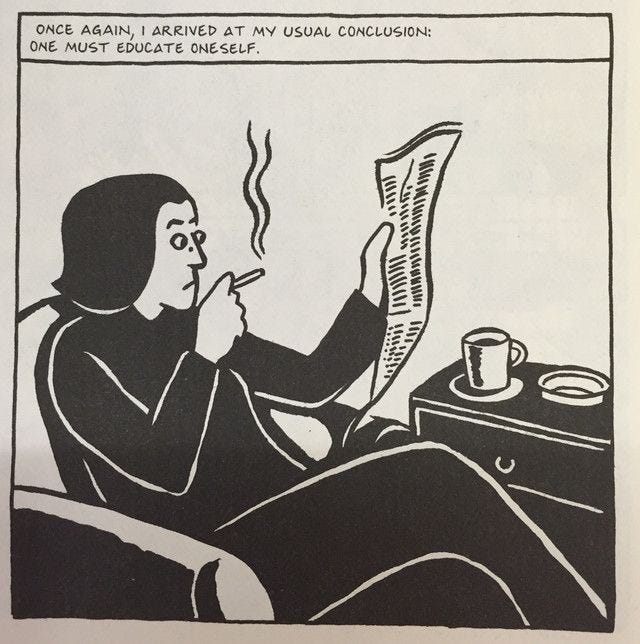
The blood is on the wall. We know why we live in the world we do. It isn’t the early 2000s, and though media manipulation does exist, it isn’t working on the masses anymore. There’s more nuance, there are more facts that circulate and are permeating, and people are educating themselves.
Persepolis, in some ways, is that education, too. How revolutionary a book and story to lay out the groundwork, to not exist in the inferior, but to exist within the framework of understanding who you are. Your ancestry. The language your people have spoken for thousands of years. This is ancestral power.
Watching Persepolis, I didn’t feel defeated. I thought all we really have is our truth, and it must come out in our art. What a miraculous place for it to be nurtured and gauged and shared, how our art becomes a place of our creative mind’s first contact.
I’m suddenly thinking of that famous Mark Fisher adage from Capitalist Realism:
“It is easier to imagine the end of the world than it is to imagine the end of capitalism.”
Our imagination has been hijacked, and continues to be sewn into the fabric of the elite’s dreams, but not the will, nor the imagination, of the people. Yet, we can easily fix this. We can change the course of our own history.
I’ve currently been reading a lot about Algeria — re-reading Frantz Fanon’s A Dying Colonialism, and I’ve also been reading about the victorious wins of the British people against the landowner and elitist class. After the Normans invaded England in 1066, they enforced feudal land laws that threw peasants into destitution and took the common lands (that were once for all) and made them private property, strengthening the landowner class. William the Conqueror enforced that because he knew that the people would divide and conquer themselves, fighting over land, when he—a fucking Norman, so a Frenchman—came and took over all of England, and kept England under Norman rule, because he developed a system of making rich people richer by taking what is everybody else’s. It’s quite absurd how this proto-capitalist ideology has continued our inhumanity against one another, but it really makes sense why war continues. As Rebecca Tamás writes, “It is Western Capitalism, land enclosure and wage inequality that is the reason for every forest fire, every heatwave, every extinction.” Tamás also quotes the potent words of LaDonna Brave Bull Allard, the Standing Rock’s Historic Preservation Officer:
“The U.S government is wiping out our most important cultural and spiritual areas. And as it erases our footprint from the world, it erases us as a people.
These sites must be protected, or our world will end, it is that simple. Our young people have a right to know who they are.
They have a right to language, to culture, to tradition. The way they learn these things is through connection to our lands and our history.”
I think of Palestine, I think of Lebanon, I think of Sudan, I think of Congo, I think of Haiti, I think of Yemen, I think of Iran.
I think of what can never be lost. We are their seeds.
I see people giving up, giving in, losing hope and losing steam… I experienced that sadness for most of last year. I couldn’t go on, I got into more and more debt and felt incapable of properly taking care of myself. Fighting against empire is no joke, especially not when you try to embody that resistance in everything that you do.
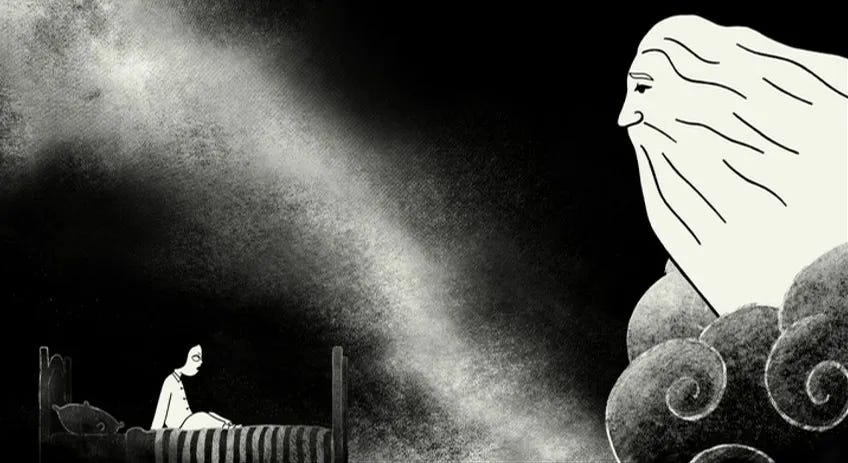
Yet we must, and that is the lesson I learned from Marjane. That no matter what, you have to learn how to tell the truth, or at the very least, what you really mean. Until death, that’s the only thing that will liberate you. Autonomy of our bodies and our minds is all we have. There’s a scene where she tries to overdose, but after a conversation with God realizes it isn’t time. Sometimes we circle death as it circles us.
As I watched Persepolis, I thanked her for what she gave us. A new direction, a way through the fire. I’ve never read anything quite like it since… it grasps so many points of contention in one’s being. It is a masterpiece, an encapsulation of a time that shifted Iran, Marjane and the world. These ripples continue. I wonder if some part of her also died of heartbreak over the world—of what was happening to her homeland, complications et al—we still long for home. May Iran be free one day soon. May we rid ourselves of supremacy—a relatively recent invention. May we evolve from people who want to kill, who want to war, who want to live in delusion.
Fanon writes: “O my body, make of me always a man who questions!”
This is the prayer I have of myself and my art.
May I always question. May I always educate myself. May I never stop.
This made me feel so seen, thank you for sharing this reflection that I can resonate so closely with ❤️
Cried through this, love you F <3